
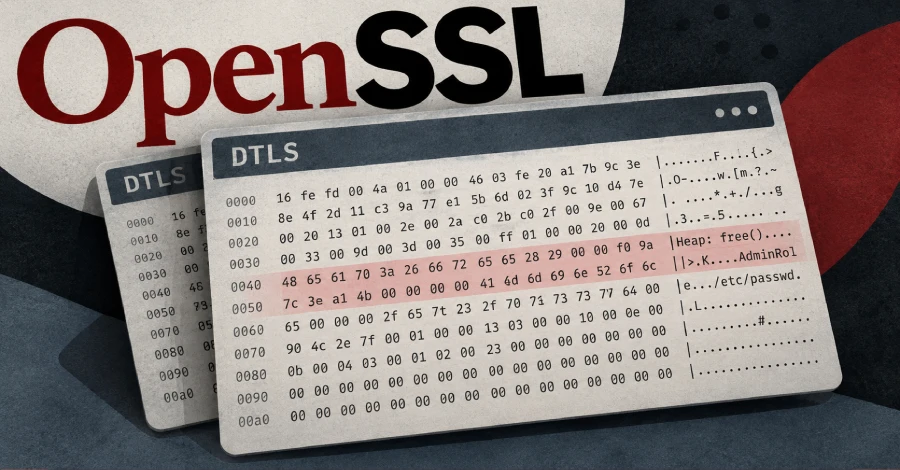
OpenSSL released fixes on September 29 for CVE-2026-84782, a High-severity bug in its DTLS implementation, the TLS variant used for UDP traffic such as WebRTC data channels and key setup for internet calls. If a handshake message resend is triggered while a larger message is stuck part-way through being sent, the library resends using the wrong buffer position. The message goes out mislabeled, carrying leftover bytes from the larger message, which can expose heap memory to the other side as unencrypted handshake data or crash the program when the read hits unmapped memory.
OpenSSL has not said whether an attacker can reliably force a resend at the right moment and reports no attacks. Laurent Gaffie of Secorizon reported the bug on August 17. CISA scored it 8.2 on the CVSS scale, and both DTLS clients and servers are affected. Only software that uses OpenSSL for DTLS is exposed. OpenSSL lists no workaround.
How to check if you’re affected
Affected versions are OpenSSL 4.0, 3.6, 3.5, 3.4, 3.0, 1.1.1 and 1.0.2 releases earlier than the fixed builds: 4.0.3, 3.6.5, 3.5.9 and 3.4.8 are public downloads, while 3.0.23, 1.1.1zj and 1.0.2zs go only to premium support customers (public 3.0 support ended September 7). Run openssl version to check your build, and identify products that use OpenSSL for DTLS, such as WebRTC gateways, VoIP and VPN software. Distributions ship fixes under their own version numbers: Ubuntu fixed it on September 29 (USN-8847-1; for example libssl3t64 3.0.13-0ubuntu3.16 on 24.04 LTS, reboot afterward), and Debian 13 has openssl 3.5.7-1~deb13u3 (DSA-6531-1), while Debian 12 was still listed as vulnerable on September 30.