
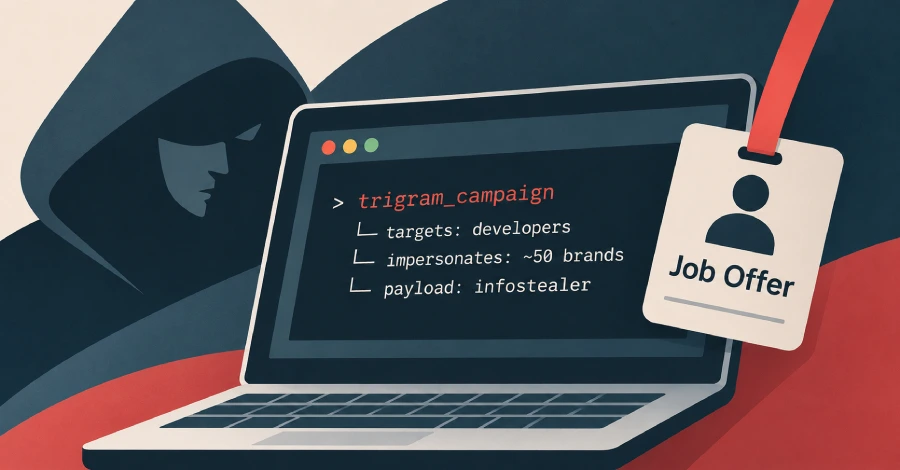
French security firm Stormshield has published a report on “Trigram”, a large campaign that impersonates about 50 companies in the blockchain and AI sectors to get developers to run an infostealer themselves. Stormshield says it targets the AI, blockchain and logistics sectors across Europe and the United States. It uses three lures: a fake recruitment process, a conference invitation, and a package-tracking notice. The report is dated November 11 and was updated November 16.
According to The Hacker News’s summary of the report, the recruitment site lets visitors browse job listings, then asks for an invitation code, which suggests the targets are chosen in advance. After the code is accepted, the candidate is told to copy a command into a Linux terminal as a “technical check”. The page then swaps what its Copy button puts on the clipboard, even if the visitor copies with Ctrl+C. Stormshield says the same flow also feeds a second-stage loader for Windows (verify_w) and one for Linux and macOS (verify_m), and that the command-and-control addresses are not written into the code but looked up through GitLab.
Stormshield assesses with high confidence that Trigram continues the cluster Proofpoint calls UNK_DeadDrop, which Proofpoint ties to the North Korean ecosystem. It cites shared infrastructure, shared tooling and similar techniques, and says it correlated its findings with research from Proofpoint, SafeDep and Genians. SafeDep, in its own analysis of a related case, says its match to the “Contagious Interview” campaign rests on technique and does not prove who the operators are. That related case is a forged commit pushed on October 31 to the antd-img-crop GitHub repository (about 98,000 weekly npm downloads, per SafeDep), which runs a credential stealer called OverLord when a developer runs npm run build. SafeDep says the npm package itself is not affected.
How to check if you’re affected
Affected products are developer machines (macOS, Linux or Windows) where someone ran a command copied from a job, conference or package-tracking website, or built a copy of the antd-img-crop GitHub repository that includes the forged commit. SafeDep lists these indicators:
- A checkout of github.com/nanxiaobei/antd-img-crop at commit
2aa850469fa1ff2e2efe8eebdf1e085e4d11212a, or aprebuildscript entry inpackage.jsonthat runsscripts/prebuild.js. - A VS Code or Cursor extension named
google-dev-tools.google-update-support. - Persistence named
com.google.UpdateSupporter,google-agent.serviceorGoogleUpdateSupporterNode, and on macOS a file dropped at/var/tmp/check. - Network traffic to domains such as
icagllmbt[.]space,api.gaganata[.]ink,buildwithknexus[.]xyzor the GitLab dead-dropgitlab[.]com/drop-indexings/tasks.
SafeDep says OverLord steals browser passwords, cookies, keychains, cryptocurrency wallets, SSH keys and .env files. If you find any of these indicators, treating those secrets as exposed and rotating them from a clean machine is our suggestion, not guidance from SafeDep or Stormshield. The full indicator lists are in the SafeDep and Stormshield pages.
Sources
- Stormshield: Trigram campaign
- SafeDep: antd-img-crop GitHub repository hijacked to deliver OverLord stealer
- Proofpoint: UNK_DeadDrop phishing campaign targets developers to steal cryptocurrency
- Genians: Operation GitPower
- The Hacker News: Trigram Campaign Impersonates About 50 AI and Blockchain Brands to Target Devs with Infostealers